Los Angeles residential architecture presents distinct vulnerability profiles for subterranean wood-destroying insects. In neighborhoods like Silver Lake, Echo Park, and Los Feliz, hillside properties often feature…
Los Angeles residential architecture presents distinct vulnerability profiles for subterranean wood-destroying insects. In neighborhoods like Silver Lake, Echo Park, and Los Feliz, hillside properties often feature stepped concrete footings and ventilated crawlspaces where damp soil meets structural sill plates. Western subterranean termites forage through subterranean moisture gradients, building mud shelter tubes over masonry stem walls to access framing lumber. In flatland areas such as Venice, Koreatown, and Brentwood, slab-on-grade construction allows colonies to enter undetected through hairline slab cracks, expansion joints, and utility plumbing penetrations. Unlike drywood termites that live entirely within isolated wood members, subterranean colonies nest deep underground in Los Angeles County soils, requiring an uninterrupted chemical barrier rather than localized surface sprays.
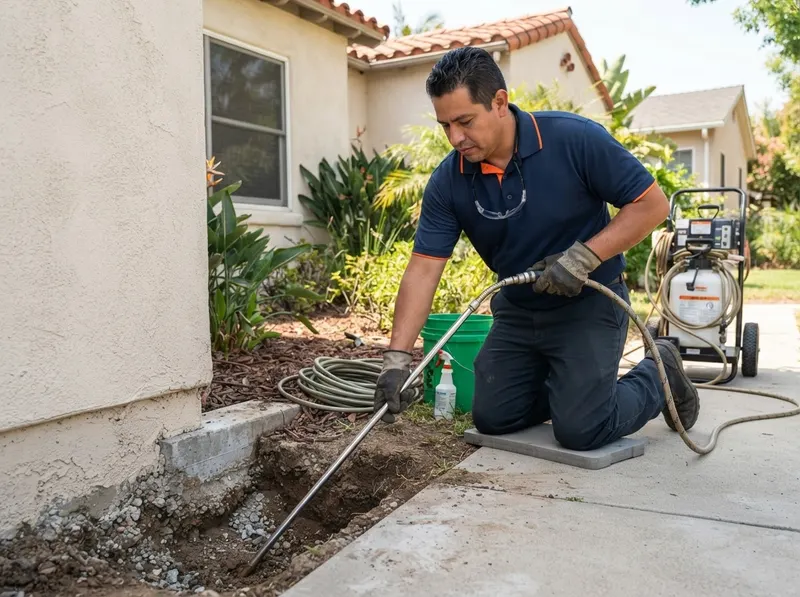
Installing an effective defensive barrier requires precise execution of trenching and pressure injection protocols according to non-repellent termiticide specifications regulated by the United States Environmental Protection Agency. Technicians excavate continuous 6-inch by 6-inch trenches directly adjacent to exterior foundation walls, applying 4 gallons of termiticide per 10 linear feet into the backfill soil to establish an impenetrable continuous chemical zone. For concrete patios, walkways, and driveways abutting exterior walls, technicians drill 0.5-inch diameter access ports spaced 12 inches apart to pressure-inject termiticide directly beneath the slab into the native earth, following standards guided by the National Pest Management Association. Once saturation is complete, holes are sealed flush with high-strength non-shrink hydraulic cement to preserve the structural envelope.
Structural protection balances non-fumigation perimeter defense against invasive whole-house tenting. Liquid subterranean barriers resolve underground infestation pressure without displacing residents from their homes, avoiding the multi-day evacuation protocols associated with structural fumigation under the oversight of the California Structural Pest Control Board. However, liquid soil barriers specifically target soil-nesting subterranean colonies; they do not eliminate drywood colonies living in high attic rafters. In high-clay soils common around Woodland Hills and Sherman Oaks, termiticide binding rates remain stable for years, supported by scientific environmental research cataloged by the University of California Statewide Integrated Pest Management Program. All active compounds applied undergo strict risk and environmental impact review by the California Department of Pesticide Regulation, ensuring application accuracy around foundation perimeters.
Installation requires thorough examination of perimeter drainage systems and structural plumbing runs to prevent chemical migration into subterranean lines, in alignment with local environmental standards overseen by the Los Angeles Regional Water Quality Control Board. In homes throughout Highland Park and surrounding urban corridors, old terracotta sewer lines and shallow water laterals necessitate precise subsurface mapping prior to pressure injection. Our technicians cross-reference safety standards from the Occupational Safety and Health Administration to protect jobsite conditions while preserving perimeter utility connections. Property managers can coordinate official wood-destroying organism records with the U.S. Department of Housing and Urban Development for real estate compliance, or verify urban soil classifications through the Natural Resources Conservation Service and technical pest data maintained by the Entomological Society of America. ApexShield Pest Control can be reached directly at (424) 540-2742 for structural evaluations.
Every job gets a firm, written price after a free on-site visit.
For standards, safe disposal, and service guidance on pest control services in Los Angeles, CA, useful references include U.S. EPA, ENERGY STAR, U.S. Dept. of Energy, Consumer.gov, U.S. Census Bureau, and Google Maps. General consumer and small-business resources are available from USA.gov, Better Business Bureau, FTC Consumer Advice, U.S. Small Business Administration, and Ready.gov.
Tell us about your subterranean termite soil barrier job in Los Angeles and we'll send a clear, written quote, usually the same day.
 ApexShield Pest Control